

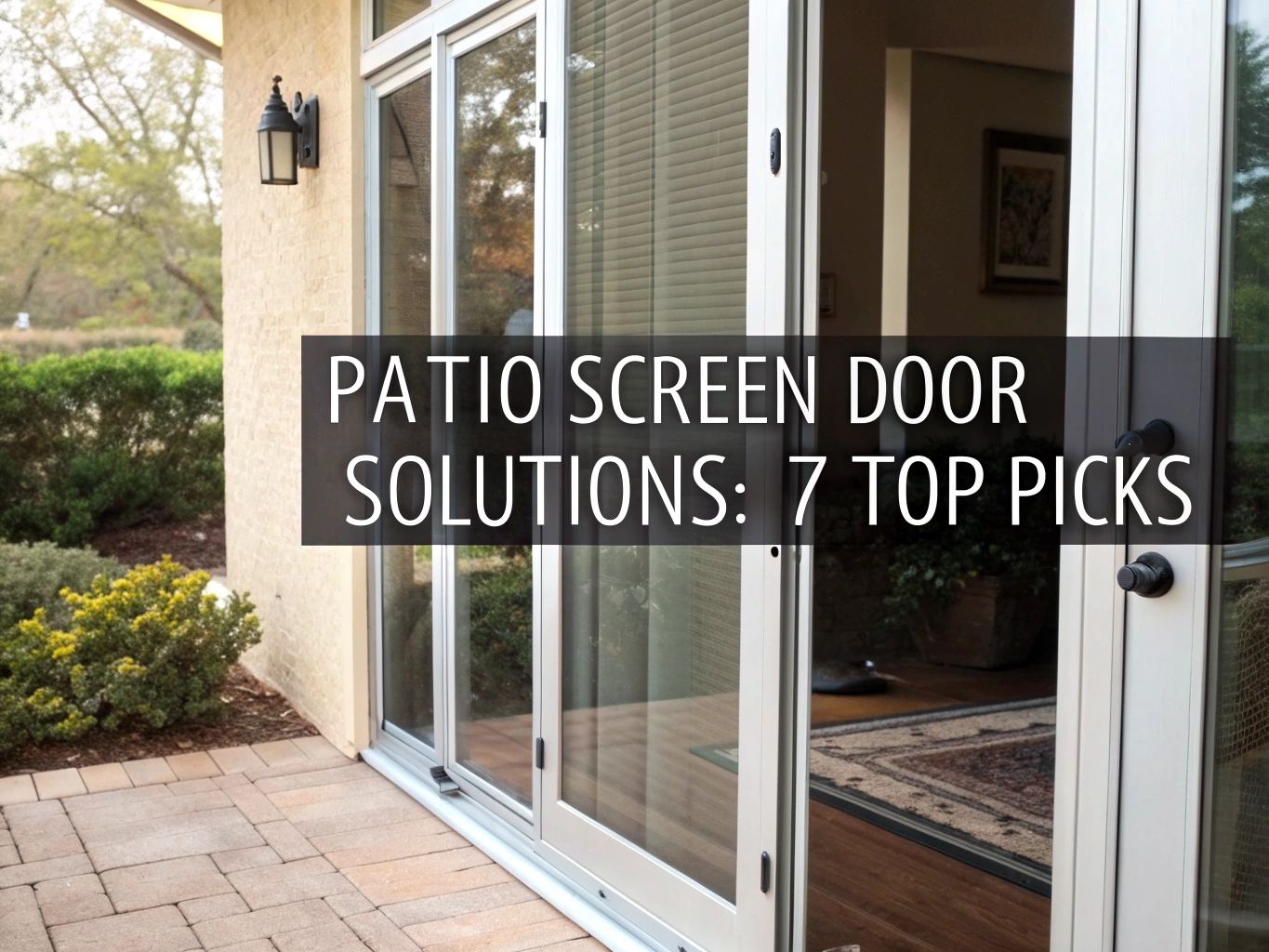
A patio screen door is a framed sliding panel, retractable screen, or magnetic mesh barrier that lets air pass while blocking insects. The right choice must match the opening, track, rollers, frame depth, handle clearance, mesh needs, and any pet-access requirements.
Table of Contents
Measure for the Correct Fit
Measure a patio door screen at several points and record the track shape before ordering. A panel can match the advertised width and height yet fail because its frame is too thick, its rollers miss the rail, or its handle strikes the glass door.
Identify the Door System
Search the glass corners, jamb, handle, and old screen hardware for a brand or model. Andersen, Pella, Milgard, Marvin, JELD-WEN, and other manufacturers may use proprietary rollers, latch positions, and frame dimensions, so an original replacement can be safer than a universal panel.
Next, identify whether the screen is bottom rolling, top hung, or held by spring-loaded guides. Bottom-rolling doors rest on wheels over a raised rail; top-hung models carry their weight from above and use the lower track mainly for alignment.
Nominal Versus Actual Size
A label such as 36 × 80 inches is a nominal size, not a promise that the outer frame measures exactly 36 × 80 inches. Listings may describe the opening, panel, adjustable range, or compatible glass-door system.
Common screen-panel labels include widths near 30, 32, 36, and 48 inches and heights near 78, 80, 81, 84, and 96 inches. Treat these as shopping categories; exact measurements and the maker’s fitting instructions control the purchase.
Width, Height, and Diagonals. Measure width at the top, center, and bottom, then measure height at the left, center, and right. Record every value rather than rounding to the nearest inch, and follow the seller’s stated clearance deduction instead of subtracting a guessed amount.
Measure both diagonals across the opening or old panel. Equal diagonals indicate a square rectangle; a difference above roughly 1/4 inch on a normal residential panel deserves investigation because roller adjustment can’t correct a badly racked frame or bowed jamb.
Track and Frame Details. Record upper-channel depth, lower-rail width, frame thickness, and the distance between roller contact points. Photograph each track beside a tape measure, since the image often reveals a recessed groove or flattened rail that written dimensions miss.
Run a clean fingertip along the lower rail. A serviceable rail feels smooth and continuous; a damaged one may feel sharp, wavy, or gritty and produce a metallic scrape as the rollers pass.
Roller and Guide Types. Note whether the wheels are exposed, recessed, spring loaded, height adjustable, plastic, metal, or ball bearing. Check the upper edge for nylon guides and anti-lift blocks because a panel that lacks matching guides may wobble or jump out.
Handle and Latch Clearance. Measure from the screen track to the stationary glass, glass-door handle, and meeting stile. Leave room for fingers around the screen pull; otherwise, the handle may rub the glass frame or pinch your knuckles every time the door closes.
Record the latch height from a fixed reference point such as the bottom track. If the original latch location can’t be matched, plan for a compatible surface latch or review suitable sliding door locks before modifying the jamb.
Adjustable and Custom Sizes. Adjustable doors use telescoping rails or extended roller travel, but maximum extension can make a light frame easier to rack. A custom screen door makes more sense for unusual tracks, architectural colors, oversize openings, or dimensions outside a safe adjustment range.
Measurement Compatibility Checklist. Record the following details on one worksheet and attach track photographs to it:
- Top, center, and bottom widths
- Left, center, and right track-to-track heights
- Both diagonal measurements
- Upper-channel depth and lower-rail profile
- Existing frame width and thickness
- Roller location, wheel shape, and adjustment range
- Handle clearance and latch height
- Opening direction and fixed-glass location
- Brand, model, finish, and visible hardware numbers
- Seller’s definition of listed product dimensions
| Measurement | Where to Check | Fit Problem It Prevents |
|---|---|---|
| Width | Top, center, bottom | Binding or a large closing gap |
| Height | Left, center, right | Derailing or failure to enter the track |
| Diagonals | Corner to opposite corner | Buying for a racked opening |
| Frame thickness | Existing panel edge | Channel and glass interference |
| Track profile | Upper and lower track | Roller or guide mismatch |
| Handle clearance | Screen track to glass hardware | Rubbing and finger pinch points |
Compare Patio Screen Door Types
Choose a screen type by matching it to the available track, opening size, passage frequency, wind exposure, pet behavior, and desired security. Magnetic curtains and rigid sliding doors both block insects, but they aren’t interchangeable products.
Rigid Sliding Doors
A rigid sliding patio screen door, also called a rolling screen door, uses a metal perimeter frame with rollers or guides. It suits an existing patio-door track and provides controlled opening, a defined latch point, and better wind stability than a loose curtain.
Roller quality matters more than it appears in a product photograph. Thin plastic wheels can develop flat spots that create a rhythmic click-click sensation, while replaceable ball-bearing rollers tend to carry a tall panel more smoothly.
Fixed Versus Adjustable Panels
A fixed panel gives a stiffer frame when its dimensions match the opening. An adjustable panel covers a broader height range and can simplify replacement, but fully extended sections may flex under pet impact or wind.
Most adjustable products alter height rather than width. Confirm the precise minimum and maximum fit range, the panel’s fixed width, and whether those measurements describe the frame or installed track clearance.
Build-to-Size Screen Kits. A kit works well when an assembled door would be expensive to ship or the opening falls between stock sizes. Check whether corners, rollers, mesh, spline, handle, latch, and bug seals are included; “kit” doesn’t always mean a complete package.
Square cuts matter. A rail cut only a few degrees off can leave the corner joint loose, and pulling mesh tight across that weak joint can twist the frame before the door ever reaches the track.

K.D. Aluminum Patio Screen Kit
- Heavy-duty aluminum frame for lasting support
- Sliding screen design fits patio door openings
- Insect screen helps keep pests outside
- White finish complements many door frames
- Kit format lets you build a 36 by 80 inch screen
 Buy on Amazon
Tall Screen Doors. Openings near 96 inches need rails that resist bowing and racking. Verify the actual fit range and freight packaging because a tall assembled frame can arrive bent, while a cut-to-size kit shifts the risk to accurate home assembly.
K.D. Tall Aluminum Screen Kit
- Built for tall 36 by 96 inch patio openings
- Sturdy aluminum frame supports regular use
- Sliding design works for patio door setups
- Insect mesh helps keep outdoor pests out
- White frame gives a finished appearance
Buy on Amazon
Magnetic Patio Screens. A magnetic screen attaches around the finished opening and closes along a weighted magnetic seam. It suits renters, seasonal use, hands-full entry, children, and pets, particularly where no usable rolling track exists.
Adhesive hook-and-loop strips bond poorly to dusty, damp, textured, or sun-heated trim. Clean and dry the surface, test the curtain’s position first, and check closure during normal breezes; crosswinds can leave the center seam fluttering partly open.

Flux Phenom Breeze Screen
- Auto-sealing magnets close after each pass
- Double-stitched mesh supports everyday use
- Keeps bugs out while letting breezes in
- Hands-free design suits pets and children
- Quick installation for sliding patio doors
Buy on Amazon
Wide Magnetic Screens. For broad sliders or French doors, measure the complete finished opening and confirm whether the seam is centered, offset, or reversible. Trim, handles, shades, and uneven masonry can interrupt the mounting border; owners comparing paired openings can also review French door screens.

Wide Reversible Magnetic Screen
- Wide design suits sliding and French doors
- Reversible opening works from either side
- Magnetic center closes after each pass
- Helps keep insects out while air flows in
- Hands-free entry is convenient for busy patios
Buy on Amazon
Retractable Screen Systems. Retractable mesh rolls into a side cassette, leaving a clearer view when stored. These systems suit wide openings and designs where a rigid panel would obstruct the opening, but their tracks need regular cleaning and the unsupported mesh may not tolerate a dog charging into it.
Type Selection Matrix. Use the table as a first filter, then confirm product-specific measurements and track requirements.
| Screen Type | Best Use | Main Trade-Off |
|---|---|---|
| Fixed rigid slider | Known track and exact dimensions | Little sizing flexibility |
| Adjustable slider | Common replacement openings | Can flex near maximum extension |
| Build-to-size kit | Nonstandard size or lower freight cost | Accurate cutting and squaring required |
| Magnetic curtain | Renters and hands-free passage | No lock and weaker wind control |
| Retractable screen | Wide opening and clear stored view | Higher price and delicate track system |
| Custom panel | Proprietary or unusual door system | Longer lead time and limited returns |
Compare Frames, Mesh, and Hardware
The best frame and mesh combination depends on panel size, climate, pets, insects, desired airflow, and available spline channel. Heavy mesh in a light frame can bow the rails, while thin fiberglass in a pet doorway may tear within days.
Aluminum Versus Steel Frames
Aluminum frames resist rust, stay relatively light, and dominate residential replacement panels. Thin aluminum can kink permanently when someone forces a stuck door, so rail shape, wall thickness, reinforced corners, and cross braces matter more than the word aluminum alone.
Roll-formed steel can feel stiffer at a similar frame size, yet scratches and exposed edges may corrode in wet or coastal settings. For a broader material comparison, see the guide to metal screen doors.
Rollers, Guides, and Latches
Look for replaceable roller assemblies with accessible adjustment screws. A cheap panel becomes expensive if a worn wheel is riveted into an unavailable housing, while common roller cartridges can keep a sound frame working for years.
Upper guides limit side movement, anti-lift blocks reduce derailment, and a pile bug seal closes the meeting-stile gap. The latch should draw the screen gently against the jamb; too much force racks the frame and makes the handle feel springy.
Fiberglass Insect Mesh. Standard fiberglass is flexible, economical, and resistant to permanent dents. A common residential weave is about 18 × 16 strands per inch, which balances airflow and protection from mosquitoes and flies.
Fine Insect Mesh. Tighter weaves such as 20 × 20 help block gnats and other tiny insects. The trade-offs are less airflow, darker outward visibility, and faster buildup of pollen or dust, which can make the screen feel noticeably still on humid evenings.
Aluminum and Solar Mesh. Aluminum mesh holds its shape but creases when struck and needs corrosion-aware installation near salt air. Solar mesh cuts glare and direct heat exposure, yet darker or denser products also reduce daylight, airflow, and the clarity of the outdoor view.
Pet-Resistant Polyester Mesh. Vinyl-coated polyester withstands claws and repeated body contact better than ordinary fiberglass. Phifer describes its PetScreen as seven times stronger than traditional insect screening, which is a manufacturer claim rather than a universal result for every frame and installation.
Pet mesh feels thicker and slightly rubbery between the fingers. That extra mass calls for a rigid frame and a spline size matched to the channel; forcing oversized spline can spread or crack a narrow aluminum groove.

Pet-Proof Sliding Patio Screen
- Pet-Proof Petscreen mesh resists pet wear
- Fully assembled for easier installation
- Adjustable height fits many US door frames
- Sliding design suits standard patio doors
- White frame provides a clean finished look
Buy on Amazon
Security Mesh Limitations. Standard insect mesh isn’t a security barrier and can’t prevent falls, restrain a determined animal, or resist cutting. Stainless security mesh works only as part of an engineered assembly with reinforced framing, fasteners, rollers or hinges, and locks; compare those systems in the security screen door guide.
Mesh and Spline Compatibility. Match spline diameter to both the groove and mesh thickness rather than reusing an assumed standard size. Spline that is too small lets the mesh creep loose, while spline that is too large can damage the channel or make installation nearly impossible.
| Mesh | Best For | Airflow and Visibility | Common Mistake |
|---|---|---|---|
| Fiberglass | Routine insect control | Good | Using it where pets push or claw |
| Fine insect mesh | Gnats and tiny insects | Reduced | Ignoring pollen buildup |
| Aluminum | Rigid traditional screening | Good | Creasing it during installation |
| Solar mesh | Glare and shade control | Varies by density | Expecting unchanged daylight |
| Pet polyester | Claws and repeated contact | Lower than light fiberglass | Using incompatible spline |
| Stainless security mesh | Engineered security assembly | Product dependent | Installing it in a weak insect frame |
Choose a Doggie Door Screen
A patio door screen with doggie door should match the pet’s shoulder height and body width while leaving enough frame strength around the opening. Decide whether you need a lockable flap, unrestricted magnetic passage, or a removable glass-door insert before buying.
Integrated Pet-Door Screens
An integrated model places a framed flap inside the sliding screen panel. Compare the clear flap opening, replacement-flap availability, locking cover, frame reinforcement, and panel fit rather than relying on a broad small, medium, or large label.
Retrofitting a pet door into a weak screen can remove too much lower-rail support. A reinforced factory panel or properly braced retrofit reduces flex and the loose metallic rattle that often appears after repeated pet impacts.
Pet Flap Sizing
Measure the widest part of the pet’s body and the height at the shoulders or withers. Use the clear flap opening, not the pet-door frame’s exterior dimensions, and follow the flap maker’s clearance guidance.
A growing puppy needs future clearance, while an older dog may need a lower step-over. Tape a cardboard opening to a doorway and guide the pet through it before ordering; hesitation, crouching, or hip contact signals that the proposed opening is too small.
Step-Over and Frame Strength. Keep the threshold low enough for the pet’s mobility without cutting through a structural rail. Small dogs and animals with joint trouble struggle with high step-overs, while a very low cutout can weaken the panel or place the flap against the track.
Sliding Glass Pet Inserts. A vertical insert fits beside the glass slider and avoids cutting the screen or glass. It is often removable, but it narrows the human passage, may interrupt the original lock, and usually needs weatherstripping plus a security bar or lock adapter.
Measure the remaining walk-through width after adding the insert. This is easy to miss on narrow doors, where the resulting passage may feel cramped when carrying groceries or moving a stroller; compare other configurations in the pet screen door guide.
Magnetic Pet Screens. Magnetic screens let pets cross through a center seam, but they don’t control access. They can’t reliably keep a pet inside, stop wildlife, or replace a rigid lockable flap.

Wide PET Magnetic Screen
- Strong PET mesh offers added durability
- Wide 74 by 82 inch size suits large openings
- Choose left or right side opening
- Magnetic closure helps keep bugs outside
- Pet- and kid-friendly hands-free access
Buy on Amazon
Locks and Weather Seals. Look for a rigid closing cover, replaceable flap magnets, pile seals, and perimeter weatherstripping. Pet flaps can tap or slap in gusts, and worn seals create a draft that feels like a narrow cold ribbon around the opening.
Pet Safety and Durability. Train the pet to pass through the opening rather than leap against the mesh. Inspect flap pivots, frame corners, spline, lower rails, and locks regularly; pet-resistant mesh still isn’t a restraint or fall-prevention device.
Repair or Replace the Screen
Repair the existing sliding screen door when its frame is straight, square, correctly sized, and supported by available hardware. Replace it when the frame is twisted, cracked, deeply corroded, incorrectly sized, or unable to hold rollers and corner joints securely.
Rescreen a Straight Frame
Rescreening preserves an original panel that already fits a proprietary track. Remove the old spline, clean the groove, measure the spline rather than guessing, and support the frame flat before installing new mesh.
Roll spline into opposite sides in stages and keep checking both diagonals. Beginners often pull the mesh drum tight; excessive tension bows the long rails inward and creates a door that binds near the center.
Replace Rollers and Hardware
Replace rollers when wheels are cracked, seized, grooved, or flat spotted. Remove one assembly for matching and record its housing dimensions, wheel diameter, mounting style, and adjustment-screw position rather than matching the wheel alone.
Handles, latches, guides, pile seals, and corner keys are also serviceable on many panels. A five-minute track cleaning and balanced roller adjustment often restores smooth travel without the cost and fit risk of a complete replacement.
Replace the Door Panel. Choose a new panel if the frame stays twisted after the mesh is removed, the corners won’t remain square, or roller mounting points have torn. A new mesh sheet won’t correct damaged structure.
Repair the Track Rail. Clean dirt and hair first, then inspect for crushed, flattened, or deeply worn areas. Some raised rails accept a formed track cap, which can create a smooth running surface without removing the entire sill.
Bent Frames and Jambs. A slight frame bow may be repairable after removing mesh tension, but a sharp crease in thin aluminum rarely returns to full strength. Check the fixed patio-door jamb too; replacing the screen won’t cure an opening that is badly out of plumb.
Repair Decision Checklist. The table separates low-cost service work from failures that usually justify replacement.
| Condition | Repair | Replace |
|---|---|---|
| Torn mesh, straight frame | Yes; rescreen and fit new spline | No |
| Worn replaceable rollers | Yes; match the complete assembly | Only if mounts are damaged |
| Missing handle or latch | Usually | If compatible parts are unavailable |
| Loose corner joint | Possible with matching corner keys | If rails or sockets are split |
| Sharp frame crease | Rarely reliable | Usually |
| Panel too short for track | No safe roller adjustment may exist | Yes |
| Worn raised rail | Clean, cap, or repair track | Screen replacement alone won’t help |
Install and Troubleshoot Screen Doors
Successful installation starts with a clean track, a square panel, and rollers set low enough for loading. After fitting the door, raise each roller in small increments until the panel is level, stable, and free moving without excessive vertical play.
Tools and Preparation
Gather a tape measure, square, level, screwdrivers, utility knife, spline roller, vacuum, stiff brush, gloves, and eye protection. Screen kits may also need a miter box, fine-tooth hacksaw, rubber mallet, drill, and an aluminum-compatible cutting blade.
Vacuum the track before adjusting rollers. Packed grit can mimic failed bearings, and oily lubricant often traps more dirt; use only a dry or manufacturer-approved product where lubrication is called for.
Rolling Door Installation
Retract adjustable rollers, lift the panel into the upper channel, and place the lower wheels over the rail. Some systems load from outside and others from inside, so follow the door maker’s sequence rather than forcing the frame past the glass panel.
Raise the left and right rollers separately until the vertical stile sits parallel to the closing jamb. Leave enough engagement to prevent derailment, fit anti-lift hardware where supplied, and test the latch without slamming the panel.

Magnetic Screen Installation. Clean and dry the mounting border, test-position the curtain, and center its magnetic seam before exposing adhesive. Keep the bottom just clear of the walking surface so it closes freely rather than dragging and bunching.
Press the hook-and-loop strip firmly along the whole perimeter and use supplied tacks only on a suitable substrate. Renters should confirm lease restrictions first, since adhesive can lift paint or leave residue on sun-baked trim.
Screen Kit Assembly. Cut rails using the kit’s formula, deburr the ends, insert corner keys, and compare diagonal measurements. Fit mesh on a flat surface and trim the surplus only after the frame remains square.
Practical Notes From Real-World Use. Stop pushing whenever a panel feels suddenly heavy. The usual cause is packed debris, a wheel leaving the rail, or excessive roller pressure; forcing it can turn a small hardware fault into a permanently bent frame.
Sticking Rolling Doors. Listen and feel as the panel moves. A steady rough drag points to debris or excess pressure, a repeating bump suggests a flat-spotted wheel, and a sharp scrape often means metal contact with a damaged rail.
Clean first, inspect the rollers second, and adjust height third. This order prevents a common beginner mistake: raising the door to clear dirt, which can reduce upper-channel engagement and make the panel easier to derail.
Derailing Screen Doors. Check roller engagement, panel height, top guides, anti-lift blocks, and lower-rail condition. A replacement panel that is too short may never become stable, regardless of how far its rollers extend.
Uneven Closing and Gaps. If the screen touches at the top but leaves a bottom gap, adjust the two rollers independently and recheck the jamb for plumb. Replace compressed pile, side bug seals, or bottom sweeps after the frame alignment is correct.
Sagging or Wrinkled Mesh. Remove the spline and reinstall it with even tension while the frame lies square. Don’t try to flatten wrinkles by pulling harder at one corner; that twists the frame and moves the problem to another edge.
Costs and Buying Checklist
A patio screen door can cost from roughly $20 to over $1,500, based on screen type, size, mesh, frame construction, freight, track work, and labor. Compare the delivered and installed cost rather than the product price alone.
Typical Price Ranges
The following 2026 planning bands are editorial estimates, not fixed retail quotes. Local labor, oversize delivery, custom finishes, proprietary hardware, and unusually wide or tall openings can move a project outside these ranges.
| Product or Service | Planning Range | Cost Drivers |
|---|---|---|
| Magnetic mesh screen | $20–$60 | Opening size, mesh, attachment system |
| DIY rigid aluminum kit | $60–$180 | Frame weight, included hardware, mesh |
| Ready-made or adjustable panel | $75–$250 | Rollers, finish, dimensions, freight |
| Custom fabricated panel | $150–$500+ | Track profile, finish, size, mesh |
| Pet-door screen or insert | $150–$600+ | Flap size, lock, frame reinforcement |
| Installed retractable system | $300–$1,500+ | Width, cassette, double-panel setup, labor |
Basic rescreening often costs less than replacing a straight original frame. Oversize assembled doors can carry high freight charges, so a lower listed price may still produce a higher delivered total than a local custom panel.
Fit and Track Checklist
- Confirm exact width and track-to-track height
- Check the product’s adjustable range and dimension definition
- Compare frame thickness with upper and lower channels
- Match bottom-rolling or top-hung hardware
- Confirm wheel shape and raised-rail position
- Check handle clearance and latch height
- Verify left- or right-side opening
- Inspect the track before blaming the old panel
- Review return terms before cutting or assembly
Frame and Hardware Checklist. Compare rail material, reinforced corners, roller accessibility, bearing type, adjustment range, upper guides, anti-lift parts, handle position, latch design, bug seals, and replacement-part availability. A slightly higher initial price can be sensible if every wear component remains serviceable.
Mesh and Pet Checklist. Select fiberglass for routine insect control, fine mesh for tiny pests, polyester for claw resistance, or solar mesh for glare control. For pets, add flap dimensions, step-over height, locking cover, frame bracing, and replacement-flap supply.
Freight and Installation Costs. Ask whether delivery includes residential lift-gate service, damage inspection, and packaging disposal. Long assembled panels are vulnerable to corner damage; inspect the carton before acceptance and photograph bent rails or crushed ends at once.
Returns and Warranties. Custom, cut, drilled, or assembled products often have restricted returns. Read exclusions covering incorrect measurements, pet damage, wind, adhesive failure, installation errors, and freight claims before changing the panel.
Replacement Part Availability. Check whether rollers, handles, latches, corner keys, weather seals, magnetic strips, and pet flaps have identifiable part numbers. A proprietary screen with no parts channel may need full replacement after one small failure.
Total Ownership Cost. Add the purchase price, delivery, cutting tools, installation supplies, track repair, labor, future mesh, rollers, and pet-flap parts. For large multi-panel openings such as a four-panel slider, include extra track length and wider-screen service costs.
Safety, Security, and Access
A standard insect screen provides ventilation and pest control; it doesn’t provide fall protection or security. Keep required exits clear, manage raised-track trip hazards, and use dedicated child, pet, locking, or guard systems where the risk calls for them.
Insect Screen Limitations
Fiberglass, aluminum, magnetic, and pet-resistant mesh can tear, pull from spline, or release from attachment strips. Never rely on a screen to stop a child leaning against it, restrain an animal, or block an intruder.
The U.S. Consumer Product Safety Commission warns that window screens are intended to keep insects out, not children in; the same practical limitation applies to lightweight patio insect screens. Review the agency’s window safety guidance for fall-prevention principles.
Child and Pet Safety
Use door alarms, child-resistant locks, supervised access, or code-appropriate guards where needed. Keep pet-door locking covers engaged when unsupervised access could expose an animal to traffic, pools, wildlife, heat, or freezing weather.
Check for finger traps between the moving screen, fixed glass, and handles. Loose lower tracks, protruding screws, sharp cut mesh, and cracked magnetic weights can also injure bare feet or paws.
Locks and Security Screens. A simple screen latch limits casual opening but offers little resistance to forced entry. Security-rated products need reinforced frames, resistant mesh, protected fasteners, and a tested locking system rather than one upgraded component in a light frame.
Egress Requirements. Don’t place a fixed pet insert, furniture, latch, or screen cassette where it blocks a required emergency exit. Local rules differ by room, building type, and location, so confirm the planned installation with the authority having jurisdiction.
Threshold Accessibility. Raised rails and retractable-screen guides can catch toes, walker tips, stroller wheels, and wheelchair casters. The U.S. Access Board door guide explains accessible door and threshold principles, while project-specific rules may set different requirements.
Low-profile guides reduce obstruction but collect grit quickly. Test the complete route with the mobility device that will use it, since a dimension that looks small on paper can feel abrupt when a front caster meets it.
Local Code Considerations. Building, fire, pool-barrier, rental, historic-district, and accessibility rules may affect screen placement, locks, egress, and thresholds. Confirm local requirements before drilling the patio frame, narrowing an exit with a pet insert, or replacing a required barrier with insect mesh.
FAQs
Are Patio Screen Doors A Standard Size?
Patio screen doors do not come in one universal standard size. Many sliding doors use common widths and heights, but measurements vary by manufacturer, door style, and installation. Always measure your existing screen panel and door opening before buying a replacement to ensure a proper fit.
How Do I Measure For A Sliding Patio Screen Door?
Measure the width and height of the existing screen door frame for the most accurate replacement size. Measure from outside edge to outside edge, then check the thickness of the frame and the roller location. If the old door is missing, measure the track opening at several points and use the smallest measurement.
Can I Replace Only The Screen Door Panel?
Yes, you can usually replace only the sliding screen door panel without replacing the glass patio door. A new panel must match the opening size, frame thickness, track type, and roller setup. If the frame is still straight and the tracks are in good condition, replacing the panel is often the simplest option.
Why Does My Sliding Screen Door Keep Coming Off The Track?
A sliding screen door usually comes off its track because the rollers are damaged, misadjusted, or blocked by dirt. Clean the bottom and top tracks, then adjust the roller screws so the door sits level. Also inspect the frame for bends and replace worn rollers if adjustment does not solve the problem.
Can I Add A Doggie Door To A Patio Screen?
Yes, you can add a pet door designed specifically for a sliding patio screen door. These inserts or replacement screen panels allow pets to pass through while keeping insects outside. Choose a pet door that fits your screen frame, accommodates your pet’s size, and does not interfere with the door track or lock.
Disclosure: LuxyDoor is reader-supported. When you buy through links on our site, we may earn an affiliate commission at no extra cost to you. As an Amazon Associate we earn from qualifying purchases.

Abdelbarie Elkhaddar
Glamorwood Ltd.
A door expert and home improvement writer with over 12 years of experience. I help homeowners and contractors choose smart, stylish, and secure doors.
Bifold Barn Door Buying Guide: Sizes, Clearance, Hardware, and Tips
A bifold barn door can add barn-style character while saving space in closets, pantries, laundry rooms, bathrooms, and tight hallways. This guide explains how they work, how to measure correctly, what hardware you need, and what to check before buying.Modern Barn Door Buying Guide: Styles, Hardware, Sizing and Costs
Choosing a modern barn door means balancing style, privacy, hardware, sizing and installation needs. This guide compares materials, room fit, costs and product options so you can choose the right modern sliding barn door for your space.





Leave a Reply