


A security screen door is a locked exterior barrier that combines ventilation and visibility with greater resistance to cutting, prying, and impact than an ordinary insect screen. Its real strength depends on the complete assembly: frame, infill, locks, hinges, fasteners, supporting structure, and installation.
Table of Contents
Security Screen Door Types Compared
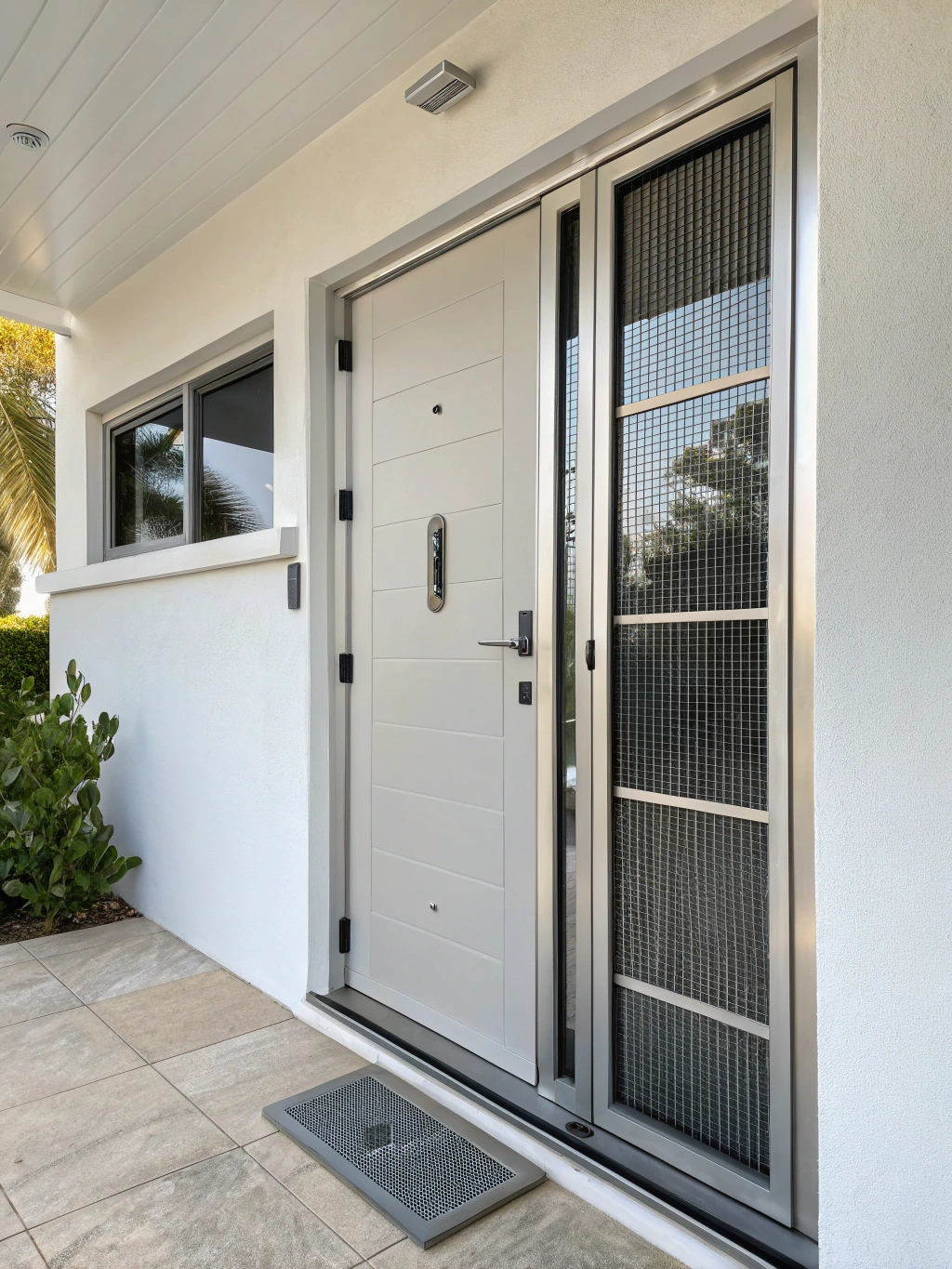
A security screen door suits homes that need airflow and another locked barrier, while solid security doors favor privacy and weather protection. Security storm doors combine glass-and-screen functions, but the word “storm” doesn’t confirm forced-entry resistance.
Security Screen Door Basics
A typical security door screen has a rigid metal frame, metal infill, protected hinges, a keyed lock or deadbolt, and structural mounting points. It’s often installed outside the primary entry door so occupants can leave that inner door open while keeping the exterior barrier locked.
Appearance can be misleading. A thick decorative grille may feel cold and solid under the hand, yet wide openings, weak welds, short screws, or an exposed thumb-turn can make the complete assembly easier to defeat than a plainer tested door.
Solid Security Doors
A solid security door uses steel, aluminum, reinforced wood, or composite construction without a large ventilated panel. It can provide better privacy and rain control, but airflow stays limited unless the design includes screened vents or an opening panel.
Panel material alone doesn’t establish resistance. A heavy steel slab fitted to a flexible jamb still has a weak point, which is why frame reinforcement matters when comparing a solid door with a steel exterior door.
Security Storm Doors
Security storm doors combine reinforced construction with storm-door features such as removable glass, retractable screens, weather seals, and closers. Glass improves rain and wind protection, while a screen panel restores airflow during mild weather.
Check whether “security” refers to the lock, frame, grille, or a tested assembly. Glass replacement can also become a long-term ownership issue, so review panel availability and our guide to storm door glass before buying a proprietary system.
Ordinary Screen Doors
An ordinary screen door controls insects and lets air pass, but its fiberglass or lightweight aluminum mesh tears with a sharp tool. Thin frames and simple latches make these doors unsuitable as a burglary barrier, regardless of how firmly the latch clicks shut.
A well-fitted hinged screen door remains useful where insect control is the main goal. Don’t treat pet-resistant mesh, heavy spline, or a decorative push bar as security features.
Benefits and Limitations
| Door type | Airflow | Insect control | Weather protection | Security potential |
|---|---|---|---|---|
| Ordinary screen door | High | High with sealed fine mesh | Low | Low |
| Security screen door | High | Varies by aperture and seals | Low to moderate | Moderate to high for a tested assembly |
| Storm door | Moderate when screened | Usually good | High with glass fitted | Low to moderate unless reinforced |
| Solid security door | Low without vents | Not its main purpose | Moderate to high | Potentially high with a strong frame and locks |
The main practical benefit is being able to see and speak with a visitor through a locked barrier while gaining natural ventilation. Limitations include wind-driven rain, reduced nighttime privacy, corrosion exposure, closer noise, and a second door that occupies landing space.
Materials and Everyday Performance
The strongest screen material isn’t automatically the best door. Everyday performance depends on aperture size, metal thickness, attachment method, coating, drainage, frame stiffness, and the conditions around the entrance.
Stainless-Steel Woven Mesh
Stainless-steel mesh provides outward visibility, airflow, and greater cut resistance than fiberglass insect screen. Compare wire diameter, opening size, stainless grade, retention method, and whole-door testing rather than accepting “marine grade” as a complete specification.
Type 304 performs well in many inland locations. Type 316 contains molybdenum and typically resists chloride exposure better, making it the preferable option near salt water; the Nickel Institute stainless-steel guidance explains how alloy composition affects corrosion behavior. Neither grade is maintenance-free, and both can develop brown tea staining from surface contamination.
Perforated Steel
Perforated steel uses punched sheet with controlled openings. It feels firm rather than springy when pressed, resists the unraveling seen in woven products, and offers a clean appearance, but small holes collect dusty gray deposits that take longer to rinse away.
Airflow falls as the solid area increases. Buyers should request the open-area percentage, sheet thickness, coating system, and information about edge treatment because exposed punched edges or installation scratches can become early rust sites.
Expanded Metal
Expanded metal starts as sheet that is slit and stretched into a diamond pattern. There are no woven strands to separate, and the construction offers a useful balance of price, rigidity, and ventilation.
Large diamonds won’t reliably stop mosquitoes or tiny flies. Raw or poorly dressed edges can feel sharp against a fingertip, so inspect the perimeter finish and determine whether a separate insect layer is included behind the metal.
Decorative Steel Grilles
Steel grilles provide a visible deterrent and suit traditional homes, yet decorative curves can create hand-sized openings near the lock. Check weld continuity, bar spacing, lock-pocket reinforcement, and whether the grille attaches directly to the frame or to a light removable insert.
A secondary insect screen is often required. If the screen sits exposed behind raised scrollwork, pet claws and cleaning brushes can snag it, so look for replaceable screen panels rather than an infill permanently trapped beneath welded sections.
Aluminum Frames
Aluminum frames don’t develop red rust and can perform well in coastal settings when the alloy, wall thickness, joints, and anchors are properly engineered. Aluminum isn’t automatically weak; frame geometry and tested assembly performance matter more than the metal name.
Mixed-metal contact needs attention. Stainless fasteners, carbon-steel inserts, trapped saltwater, and damaged coatings can promote galvanic corrosion, so the frame should include compatible hardware, drainage paths, and isolation where the manufacturer requires it.
Insect Mesh Layers
Fiberglass and thin aluminum insect mesh can sit behind a grille or expanded-metal panel, but they shouldn’t serve as the principal security barrier. Fine mesh blocks smaller pests while adding airflow resistance and collecting more pollen.
Replaceable layers are easier to service after pet damage. Confirm how the screen releases before purchase; one-way mounting screws can turn a simple rescreening job into frame removal or drilling.
Airflow and Insect Control
Effective airflow depends on the panel’s open area, decorative obstructions, wind direction, and pressure difference through the home. Fine insect mesh often produces a softer, quieter breeze than open expanded metal, particularly when windows on the opposite side of the building are closed.
Insect control fails most often at the threshold rather than through the panel. A bright strip of daylight under the sweep signals a path for mosquitoes, so align the threshold, fit side seals, and adjust the closer until the latch engages without being slammed.
Privacy and Weather Protection
Dark mesh can provide daytime privacy by reducing the view from a brighter exterior into a dim room. At night, interior lights reverse that effect, making people and furnishings easier to see from outside.
Woven and perforated panels admit wind-driven rain, so a security screen door shouldn’t be treated as a sealed storm door. Exposed entrances may need an overhang, drained sill, or a glass-panel system such as the designs discussed in our wood storm door guide.
Security Features and Testing
A secure door works as a connected assembly. Strong mesh can’t make up for weak anchoring, removable hinge pins, an exposed lock, or a frame screwed only into decorative trim.
Frame and Anchoring
The mounting frame must transfer impact and prying loads into structural framing or suitable masonry. Ask for the required fastener diameter, length, spacing, edge distance, and substrate rather than relying on a bag of generic screws.
Old brickmould can look sound while feeling soft when a pilot bit enters it. Probe questionable wood, repair decay, and use an appropriate exterior door frame solution before mounting a heavy steel unit.
Locks and Strike Protection
A multi-point lock secures the door near the top, center, and bottom, spreading force more effectively than a single latch. A well-reinforced single deadbolt can still perform well when its bolt enters a structural receiver instead of a thin frame wall.
Check cylinder grade, backset, bolt throw, lock-box construction, and strike attachment. Smart features add convenience, but electronics can’t correct a flexible frame or shallow bolt engagement.
Hinges and Fasteners
Outswing doors expose the hinge side, so use non-removable pins, hinge-side studs, welded hinges, or another anti-lift design. Screw-mounted hinges need fasteners that penetrate the intended structural material.
One-way screws discourage casual removal but make later alignment and replacement difficult. Where the product permits it, rated tamper-resistant fasteners offer better service access, provided their heads, length, and embedment match the installation instructions.
Infill Retention
The retention system may fail before stainless mesh or steel sheet. Continuous clamping, engineered channels, welded connections, or closely spaced mechanical fasteners tend to distribute force better than isolated attachment points.
Ask whether the same retention method appeared on the tested sample. Adhesive can assist sealing or vibration control, but adhesive-only retention shouldn’t be assumed to offer high forced-entry resistance without supporting test data.
Reach-Through Protection
Reach-through risk arises when an opening allows access to an interior lever, thumb-turn, key, or smart-lock control. Measure the shortest hand path through every nearby grille opening rather than checking only the hole directly beside the lock.
Moving the lock isn’t always possible because it may create handle collision with the primary door. A smaller-aperture infill or protected lock shield often solves the issue without using a double-cylinder lock that could hinder emergency exit.
Forced-Entry Standards
Forced-entry testing is more useful than staged kicking or knife videos because a named method defines the specimen, tools, loading, sequence, and pass criteria. In the United States, relevant references can include ASTM F476, AAMA 1304, and ANSI/BHMA standards for door hardware.
ASTM F476 covers security performance of swinging door assemblies. Australian products may cite AS 5039, AS 5040, and AS 5041, but those claims don’t automatically meet a US building code, insurer rule, or project specification.
Certification Claims
Ask for the exact standard, edition, performance level, laboratory, report number, and tested configuration. Certification for one panel size, lock, or frame may not cover a larger door, substitute cylinder, double-door arrangement, or revised mounting method.
Avoid absolute terms such as burglar-proof, cut-proof, or kick-proof. Accurate descriptions include forced-entry resistant, cut resistant, reinforced, or independently tested to a named level.
Fire and Emergency Egress
A security door must permit safe emergency release where it forms part of a required exit path. Keyed interior cylinders, unfamiliar multi-step releases, blocked outswing paths, and double doors with hard-to-find bolts can delay escape.
Local rules control the final installation, especially in rentals, multifamily buildings, and sleeping-room escape routes. The International Code Council code library provides model-code references, while the local building or fire authority determines adopted requirements and amendments.
Security Door Sizes and Measurement
Measure the exterior mounting opening, not just the primary door slab or its nominal label. Three widths, three heights, both diagonals, mounting-face depth, and hardware clearances reveal whether a stock unit can fit.
Mounting Opening Measurements
Measure width at the top, middle, and bottom, then height at the left, center, and right. Record measurements to the nearest 1/8 inch and follow the manufacturer’s rule for selecting from them; many instructions use the smallest measurement, but product-specific fit ranges take priority.
Nominal Versus Actual Size
A 36-by-80 label is a nominal size, not a promise that the outside frame measures exactly 36 by 80 inches. Surface-mount systems may require a stated opening range and a separate amount of flat trim around that opening.
Don’t order solely from the existing entry-door label. Compare your measurements with the exact installation manual, much as you would when learning how to measure a storm door.
Common Door Sizes
Common residential labels include 30, 32, 34, and 36 inches wide by 80 inches high. Stock availability tends to favor 32-by-80 and 36-by-80 doors, while tall, arched, double, and unusually narrow openings often require custom fabrication.
Handle and Trim Clearance
Measure both handles from their mounting surfaces to their outermost points. Two lever sets can collide between closed doors, so check handle-to-handle clearance, deadbolt positions, closer space, brickmould width, lights, cameras, doorbells, siding, and overhead trim.
Handing and Swing
Many surface-mounted doors swing outward. Determine the hinge side while standing outside, but use the maker’s diagram because handing terminology varies between brands.
Open the proposed swing with a tape or straightedge before ordering. Railings, shallow landings, walls, porch lights, and steps can prevent a full opening, while wind can pull a wide outswing door from the user’s hand.
Out-of-Square Openings
Measure both diagonals; equal readings indicate a square opening, while a difference signals frame distortion. Small variations may be manageable within the product’s adjustment range, but large differences can produce rubbing, uneven gaps, and incomplete deadbolt engagement.
Don’t force the mounting frame to follow twisted trim. Repair or pack the substrate first, then keep the hinge side plumb and verify that the latch-side reveal remains even from top to bottom.
Preorder Measurement Checklist
- Measure opening width at the top, middle, and bottom.
- Measure height at the left, center, and right.
- Compare both diagonal measurements.
- Measure the flat mounting face on all four sides.
- Record primary-door handle and deadbolt projection.
- Check the outswing path, landing, railing, lights, and camera.
- Identify wood, masonry, metal, stucco, or stone behind the trim.
- Photograph each measurement with the tape visible.
- Check threshold height, sweep clearance, and closer space.
- Match every figure to the exact product manual before ordering.
This preorder check prevents the most expensive beginner error: buying a nominally correct door that lacks mounting-face width or handle clearance. Keep the photos until installation is complete because they also help settle measurement and delivery disputes.
Security Screen Door Costs
A basic stock steel security screen door commonly costs about $200 to $600 door-only, while upgraded stock systems often fall between $600 and $1,500. Premium custom stainless-mesh systems may reach $1,500 to $4,000 or more installed.
Stock Steel Door Prices
The $200–$600 range usually covers basic welded steel, expanded-metal, perforated, or decorative grille doors in common sizes. Lower prices may exclude handles, cylinders, closers, sweeps, or installation hardware.
Upgraded Stock Door Prices
Expect roughly $600–$1,500 door-only for heavier frames, more detailed designs, improved locks, replaceable screens, better coatings, or less common sizes. Price still doesn’t prove forced-entry testing, so compare specifications and reports separately.
Custom System Costs
Custom stainless-mesh or tested systems often cost $1,500–$4,000+ installed. Double openings, arches, sidelights, transoms, 316 stainless, multi-point locks, custom colors, and premium cylinders can push totals beyond that range.
Installation Cost Drivers
Labor rises with masonry drilling, damaged trim, stucco repair, structural work, custom fabrication, old-door removal, restricted access, or extensive lock preparation. A square wood-framed opening with a flat mounting surface is usually the least costly case.
Frequently Excluded Items
Common exclusions include handles, lock cylinder, closer, bug sweep, threshold adapter, special anchors, delivery, disposal, trim repair, custom finish, permits, and smart-lock work. Ask whether sales tax and return freight for a mis-sized unit appear in the quote.
Comparing Complete Quotes
| Quote item | What to confirm | Common hidden cost |
|---|---|---|
| Door and frame | Exact size, material, finish, infill | Custom fabrication or color |
| Lock hardware | Cylinder, handles, strike, keys | Hardware sold separately |
| Installation | Anchors, shimming, alignment, sealing | Masonry or trim repair |
| Accessories | Closer, sweep, bug seals, threshold | Separate accessory kits |
| Aftercare | Labor warranty, finish warranty, parts | Service-call or freight fees |
Compare the installed total, not the panel price. A cheaper unit can cost more after separate hardware, delivery, threshold work, and labor are added.
Security Screen Door Product Examples
These products illustrate stock steel door formats, finishes, and sizes; their listings don’t prove independent forced-entry certification. Verify the fit range, current specifications, hardware, warranty, installation manual, and test documentation before purchase.
Traditional Steel-and-Wood Door

Prime-Line Woodguard Security Door
- Steel and wood construction
- Bronze finish suits traditional exteriors
- Adds a protective entry barrier
- Designed for security door applications
- A durable option for front entryways
 Buy on Amazon
The Prime-Line Woodguard suits buyers who prefer a traditional bronze appearance over a plain industrial panel. Confirm exact dimensions, screen construction, hardware inclusion, wood finishing needs, and whether the entrance has enough shelter to limit moisture exposure.
Perforated Steel Doors

JUBEST Black Perforated Steel Door
- 36 by 80 inch exterior door size
- Steel construction for stronger entry protection
- Perforated screen supports airflow
- Black finish offers a modern look
- Built for security screen door use
Buy on Amazon

JUBEST White Perforated Steel Door
- 36 by 80 inch exterior door size
- Steel construction for dependable protection
- Perforated screen promotes ventilation
- White finish complements light trim
- Made for secure exterior entries
Buy on Amazon
These black and white 36-by-80 examples use perforated steel for a uniform modern face. Request the opening range, sheet thickness, open-area percentage, insect aperture, coating warranty, and a list of included lock parts before comparing them by color.
Reversible Surface-Mount Door

JUBEST Reversible Steel Security Door
- 36 by 80 inch security door size
- Steel build reinforces exterior entryways
- Surface mount installation design
- Reversible configuration adds placement flexibility
- Made for secure screen door applications
Buy on Amazon
A reversible configuration offers hinge-side flexibility, but it doesn’t remove the need to check lock orientation, closer placement, primary-handle collision, and outswing obstructions. Follow the brand’s handing diagram before drilling any lock or mounting holes.
Expanded-Metal Doors

JUBEST Black Expanded Metal Screen Door
- 36 by 80 inch steel security door
- Expanded metal screen allows airflow
- Powder-coated black frame resists rust
- Universal reversible outswing design
- Handles are sold separately
Buy on Amazon

JUBEST White Expanded Metal Screen Door
- 32 by 80 inch steel security door
- Expanded metal screen supports ventilation
- White powder-coated frame resists rust
- Universal reversible outswing design
- Handles are sold separately
Buy on Amazon
These examples offer 36-by-80 and 32-by-80 options with expanded-metal infill. Their supplied descriptions state that handles are sold separately, so include a compatible lockset in the budget and verify that the diamond aperture blocks the insects common in your area.
Insect-Resistant Steel Door

White Steel Mosquito-Proof Security Door
- 32 by 80 inch steel screen door
- Mosquito-proof screen helps block insects
- Breathable design lets fresh air pass
- White powder-coated frame resists rust
- Handles are not included
Buy on Amazon
This 32-by-80 white door targets buyers who prioritize mosquito control. The supplied description says handles aren’t included, and the result still depends on side seals, sweep contact, threshold alignment, closer adjustment, and reliable latching.
Specifications to Verify
- Actual outside frame dimensions and acceptable mounting-opening range.
- Flat mounting-face width required on every side.
- Frame section, steel thickness, infill thickness, and attachment method.
- Lock, cylinder, handles, closer, sweep, seals, and anchors included.
- Hinge-side protection and exposed fastener type.
- Coating system, coastal suitability, and finish warranty.
- Named test standard, grade, report, and tested configuration.
- Replacement screens, lock parts, sweeps, and keys.
- Return terms for freight damage or measurement errors.
Treat dimensions and included hardware as purchase-critical details. Product photographs often show handles or accessories that aren’t supplied, and a “36-by-80” title may omit the narrower acceptable opening range stated in the manual.
Installation and Maintenance
A correctly installed door should swing smoothly, close without a harsh bang, latch without lifting the handle, and show even gaps around the frame. Real-world failures usually begin with poor alignment, trim-only fastening, unsealed penetrations, or neglected coating damage.
DIY Installation Suitability
DIY work is reasonable for a stock surface-mount door fitted to a square opening with sound wood framing and clear instructions. The installer needs accurate drilling skills, suitable bits, levels, shims, structural fasteners, and enough help to control the heavy door panel.
Stop if the frame is decayed, the substrate is unclear, or the opening requires cutting structural material. A security door is less forgiving than a light patio screen door because small alignment errors can prevent full bolt engagement.
Professional Installation Needs
Professional installation is the safer choice for masonry, stone, stucco, metal framing, arches, double doors, sidelights, multi-point locks, or damaged openings. Use an approved installer where warranty coverage or certified assembly performance depends on prescribed anchors and installation methods.
Custom openings need site measurement before fabrication. For large paired entries, compare the structural and sealing issues discussed in our guide to double storm doors.
Surface-Mount Installation Steps
- Inventory the frame, door, lock parts, closer, seals, and specified fasteners.
- Dry-fit the frame and check the swing, handles, threshold, lights, and landing.
- Set the hinge side plumb, then fasten it according to the installation manual.
- Hang the panel and support its weight without twisting the frame.
- Set the head and latch-side frame with even reveals.
- Fit the lock, reinforced strike, cylinder, and handles.
- Install the closer, sweep, and perimeter insect seals.
- Test latch and deadbolt engagement from both sides.
- Test emergency release without a key where code requires it.
- Seal approved exterior penetrations against water.
Leave final tightening until alignment has been checked through several open-close cycles. A door can look square while supported, then sag enough to scrape the threshold once its full panel weight loads the hinges.
Common Installation Mistakes
Frequent mistakes include fastening into trim only, tightening the frame before checking diagonals, using the wrong masonry anchors, reversing hardware without instructions, and leaving a threshold gap. Excessive closer tension causes door slamming, while weak tension can leave the latch resting against the strike.
A useful workaround is to mark the deadbolt with removable chalk, close it gently, and inspect the transfer point on the receiver. This exposes slight vertical misalignment without grinding away a large strike opening that weakens lock support.
Routine Inspection
Every few months, inspect anchors, welds, coating, mesh retention, hinges, strike alignment, sweep, seals, and closer mounts. After severe wind or an impact, check sooner for fresh rub marks, loose fasteners, shifted gaps, or a bolt that no longer enters fully.
A practical test is to close the door slowly using one finger on the handle. Grinding, a gritty lock turn, metallic ticking, or a sudden change in resistance can reveal movement before the door visibly sags.
Cleaning and Lubrication
Wash mesh and coated frames with mild detergent, clean water, and a soft cloth or brush. Avoid steel wool and aggressive abrasives because they scratch coatings and may leave carbon-steel particles that create orange surface spots on stainless mesh.
Use only lock and hinge lubricants approved by the manufacturer. Heavy oily sprays attract grit, which creates a black paste inside cylinders and can make keys feel rough during rotation.
Rust and Coating Repair
Repair chips before corrosion spreads beneath the finish. Remove loose material using the maker’s approved method, clean and dry the area, apply a compatible primer where required, then use matching exterior touch-up coating.
Pay close attention to welds, cut edges, screw heads, and the bottom rail. Water tends to linger there, and repeated sweep contact can abrade powder coating until bare steel appears.
Coastal Maintenance
Salt exposure calls for more frequent fresh-water rinsing, clear drainage, compatible fasteners, and quick coating repair. Type 316 mesh offers better chloride resistance than 304 in many applications, but coastal cleaning remains necessary.
Don’t let fertilizer, masonry dust, or metal grinding residue settle on the door. These contaminants can stain stainless surfaces and attack damaged coatings long before broad rust becomes visible.
Security Door Buyer Checklist
Choose a security screen door by checking the whole opening, not one impressive component. Fit, anchoring, lock protection, safe release, corrosion resistance, included hardware, and parts support should all meet the home’s conditions.
Assembly Security
- Identify any named forced-entry standard, grade, report, and tested configuration.
- Check how the panel or mesh is retained in the frame.
- Confirm that hinge pins can’t be removed from outside.
- Inspect lock-box and strike reinforcement.
- Check decorative openings for reach-through access.
- Confirm that anchors connect to structural wood or suitable masonry.
A door that passes these checks can provide meaningful entry delay, but no residential product is impossible to defeat. Use it with a secure primary door, exterior lighting, clear sightlines, and sensible locking habits.
Fit and Clearance
Confirm the mounting-opening range, actual frame dimensions, flat trim width, hinge side, swing path, threshold, closer space, and both handle projections. For unusual widths or shapes, compare the advantages of custom screen doors before altering sound masonry or trim to fit a stock product.
Included Hardware
Ask for a written list covering the door, mounting frame, screen, lock body, cylinder, keys, inside and outside handles, closer, fasteners, sweep, seals, strike, and installation template. Product images don’t establish box contents.
Material Durability
Record frame metal, wall or sheet thickness, infill material, stainless grade, coating type, drainage design, and coastal restrictions. Steel offers economical rigidity, while engineered aluminum and 316 stainless components may reduce corrosion concerns in salt-heavy locations.
Installation Requirements
Confirm approved mounting substrates, anchor specifications, sealants, installer qualifications, permits, and emergency-release rules. Read the full manual before ordering, since some tested systems require authorized installation to retain warranty or certification coverage.
Warranty and Replacement Parts
Separate the finish, hardware, screen, and labor warranties because their terms often differ. Ask whether replacement locks, cylinders, handles, sweeps, closers, and screen panels will remain available, and who pays service freight or removal labor.
A well-chosen security screen door is worthwhile when it fits accurately, anchors into sound structure, releases safely, and receives routine care. Buy the complete installed system rather than the strongest-sounding material claim.
FAQs
Are Security Screen Doors Worth It?
Security screen doors are worth it when you want better airflow, insect protection, and an added layer of entry security. A quality model can discourage opportunistic break-ins while letting fresh air circulate without opening your main door. Value depends on the frame, mesh, locks, and professional installation, so choose a product rated for your climate and doorway.
Can A Security Screen Door Be Kicked In?
A properly installed security screen door is difficult to kick in, but no door is completely impossible to force open. Reinforced frames, heavy-duty hinges, three-point locks, and secure mounting into the wall or door frame make a major difference. Avoid lightweight decorative screens, and have the lock side and strike plate professionally anchored for stronger resistance.
How Much Does A Security Screen Door Cost?
A security screen door typically costs about $500 to $2,500 installed, depending on size, material, mesh, locks, and customization. Basic aluminum models cost less, while steel frames, premium stainless mesh, and double-door designs increase the price. Request an on-site quote because fitting, removal, and installation conditions can affect the final total.
How Do You Measure For A Security Screen Door?
To measure for a security screen door, measure the width and height of the opening at several points and use the smallest measurements. Check the opening depth, hinge side, handle clearance, threshold, and any trim or obstructions. Measure from the correct mounting surface rather than the existing door, and confirm the manufacturer’s requirements before ordering.
Is Steel Or Aluminum Better For A Security Door?
Steel is generally better for maximum security, while aluminum is better for lighter weight and corrosion resistance. Steel doors are usually stronger and more rigid, but they need a durable finish to prevent rust. Aluminum suits coastal or humid areas and can still be secure when paired with strong mesh, locks, and reinforced framing.
Disclosure: LuxyDoor is reader-supported. When you buy through links on our site, we may earn an affiliate commission at no extra cost to you. As an Amazon Associate we earn from qualifying purchases.

Abdelbarie Elkhaddar
Glamorwood Ltd.
A door expert and home improvement writer with over 12 years of experience. I help homeowners and contractors choose smart, stylish, and secure doors.
Bifold Barn Door Buying Guide: Sizes, Clearance, Hardware, and Tips
A bifold barn door can add barn-style character while saving space in closets, pantries, laundry rooms, bathrooms, and tight hallways. This guide explains how they work, how to measure correctly, what hardware you need, and what to check before buying.Modern Barn Door Buying Guide: Styles, Hardware, Sizing and Costs
Choosing a modern barn door means balancing style, privacy, hardware, sizing and installation needs. This guide compares materials, room fit, costs and product options so you can choose the right modern sliding barn door for your space.




Leave a Reply